A disappointing God, a sympathetic Devil, and a very human Jesus
A little premise:
I am not good in writing reviews. I don’t consider myself a literary critic and, therefore, I kind of suffer of imposter syndrome. However, I think it would be helpful to push myself out of this comfort zone and share my personal observations on the book I read. I don’t want to review books I don’t like, as I believe in spreading positiveness rather than negative approaches.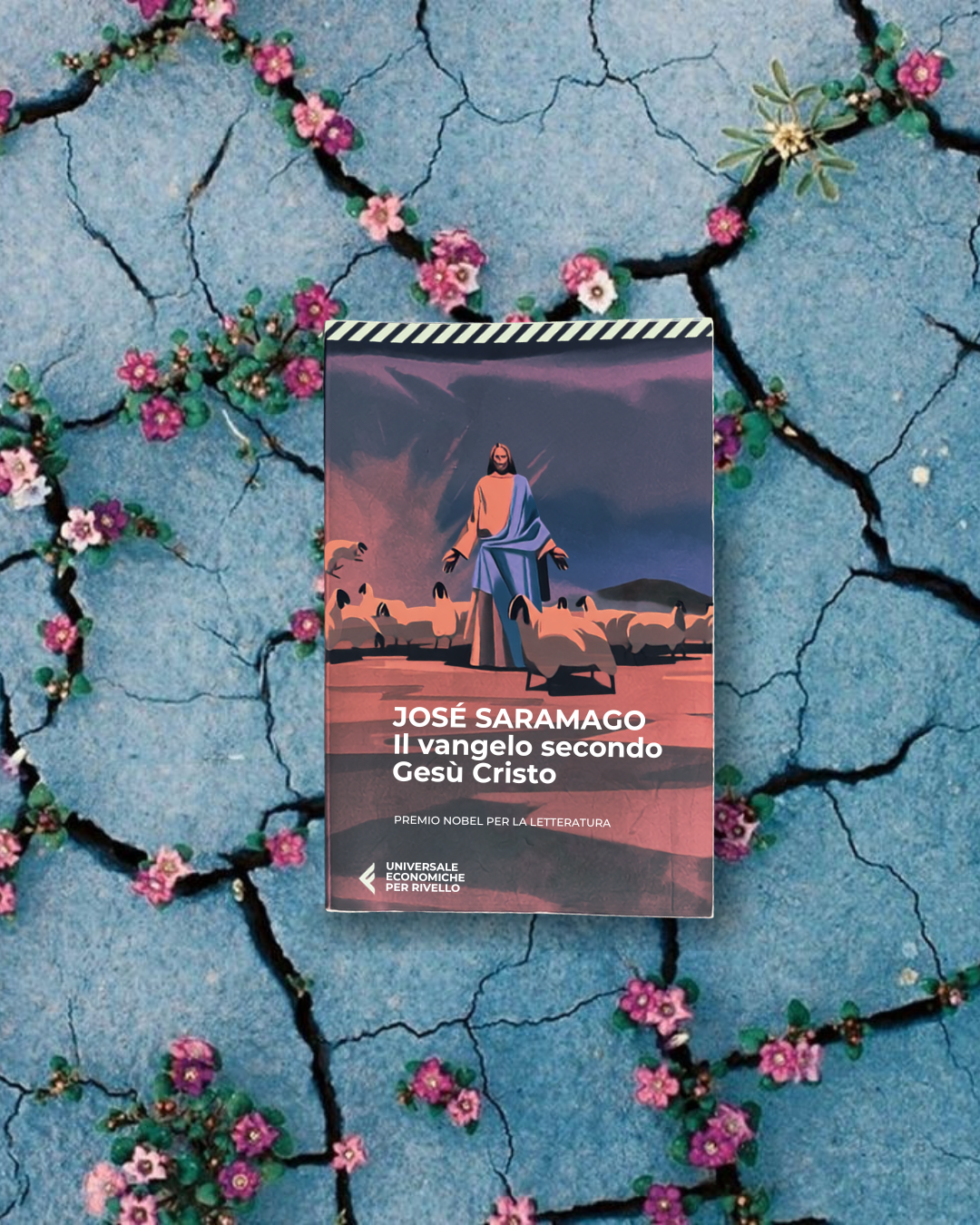
That said, I would like to start with “The gospel according to Jesus Christ,” by José Saramago. I adored the brilliant and devastating “Blidness” (and the not-as-much-great sequel, “Seeing”). He is one of my favourite authors, even though the peculiar style makes me sometimes feel a bit frustrated and requires me to re-read entire paragraphs, due to my weak attention span.
The publishing of the Gospel has been another turning point for Saramago’s life: hitting the shelves in 1991, the novel immediately rose criticism and shame from the Catholic Church. At that time, Portugal was trying to catch up with modern industry, thanks to the democratic European Economic Community’s funds, under conservative Prime Minister Aníbal Cavaco Silva, yet being still culturally traditional and deeply Catholic. The religious influence was way so rooted in such that, as Julian Evans writes on The Guardian:
The Vatican complained and, under pressure from Catholic factions in the Portuguese government, the novel was withdrawn from competition for the European Union's Ariosto prize. […] The novelist, who 20 years previously had risked imprisonment on behalf of the Portuguese revolution, was so angry that he and his wife Pilar quit Lisbon and moved to the Spanish island of Lanzarote in the Canaries, where they now live. [1]
José Saramago died in Tias in 2010.
The Gospel is a loose retelling of the New Testament, grounding the main characters in human reality and seasoning it with Saramago’s personal neat, brutal sarcasm. The novel starts and ends with the Crucifixion: the first chapter is a detailed depiction of a classic iconographic painting, a sort of memento mori for both the reader and the characters. Through the painting, the author shows the story of Jesus Christ as we generally know it, as stating a research question that needs to be put into discussion with the following gospel. A very clever frame.
“It just isn't possible for you to ask me all the questions, or for me to give you all the answers.”
More than half of the novel is dedicated to Joseph and Mary, starting from the day of the conception, which is far from immaculate but even more believable. We follow the couple to Jerusalem, where Jesus is delivered in a cave around Bethlehem. At this point, one of the big turning points is enacted: while working as a carpenter on one of the construction sites in the city of Jerusalem, Joseph overhears Roman soldiers talking about the order from King Herod to kill all infants under three years of age. The man runs back home, but on the way, he fails to warn the other families in Bethlehem, and this leads to the episode of the Slaughter of the Innocents.
Aside the actual gruesome of the slaughter, the event introduces a main theme that shapes various chapters in the novel: the concept of guilt. Saramago dedicates a deep introspection about guilt and how it moves humans. Joseph’s failure is unforgiving and unfixable, therefore it brings him to being tormented by the nightmare of seeing himself as a roman soldier sent to kill his own son. The tormented sleep leads Joseph into depression and anxiety, forcing Mary into multiple pregnancies in the hopeless attempt to redeem himself for the tens of infants murdered in Bethlehem. Yet he will be relieved from the guilt only in the moment he finds himself crucified as innocent, among other forty rebels. In that moment, although, the nightmare is passed down to the teenage Jesus.
“Guilt is a wolf that devours the father as it devours the son.”
After Joseph’s death, Jesus has a spiritual crisis due to the nightmares and the weight from the infants’ slaughter on his shoulders, so he leaves Nazareth for Jerusalem. Once there, after a disappointing consultation at the Temple, he is approached by the Devil who presents himself as the “Pastor” and invites him to lead a herd of sheep together for four years… until Jesus meets God for the first time and unknowingly accepts his destiny.
In Saramago’s novel, the Devil is more sympathetic, yet still filled with envy and resentment towards both humanity and God. In him, Jesus finds an awkward new parental figure. Even in front of God, Jesus defines himself as the son of Joseph only, refusing the divine descent. The themes of parenthood and family are quite important in the novel and remain contemporary. The classic Catholic family — represented by (Holy) Mary, who rejects Jesus when he tells her about his first encounter with God and calls him liar, and God, who approaches Jesus claiming the label of Father even though he doesn't care about his well-being — is depicted as forced relationships; while, on the other side, Jesus openly defines Joseph, Mary Magdalene, and the disciples as “his real family.”
“Who are my mother and brothers, my mother and brothers are they who believe me when I speak, they are the fishermen who know that when I join them, they will catch more fish than ever, my mother and brothers are they who do not have to wait for the hour of my death to take pity on my life.”
José Saramago anticipates the today’s conversations around the concept of chosen family. Isn’t family the collective of people who love and cherish you, rather than just the ones who bring you to this world?
And God is a disappointing father, as Richard Eder describes in the last, revealing divine meeting:
The Galilee fog-summit--one more of Saramago’s nicely implanted ironies--will clarify matters. God tells Jesus that He is tired of being worshiped only by the Jews. He has created a Son to be a divine victim whose death will vastly enlarge the numbers of the faithful. Satan sits sardonically silent; his presence is required since whenever God’s kingdom is enlarged, so is the devil’s. [2]
Even as an atheist work, the delicacy of the approach to Joseph, Mary and Jesus himself is full of respect. After the Catholic shaming storm, readers and scholars around the world still praise in admiration:
There’s nothing anti-christian in this book. [3]
Jesus remains very human, albeit a human concerned about theological matters and about the issue of guilt. [4]
I found a human Jesus, who gets angry, who has a conflictual relationship with his parents, who runs away, rebels, who has defects but who is, despite everything, a great man. [5]
Despite the banishment from the Catholic Church, the realism and humanity in this retelling bring religion’s actors closer to us. The reader can understand them, see himself in their choices, doubts, and frustration.
As a person who grew up in a Catholic-shaped culture, it was interesting to see Jews discuss morals and ethics with the elders in the synagogues and temples. The school education (at least for men) looks based on critical thinking and philosophy, instead of indoctrination in mere religious dogmas. Even though I still wonder what the actual experience in the Jewish community is like, the historical representation in the Gospel made made me feel as if the right for a religion awareness had been taken away from the believers with the introduction of Christianity in order to never be contested. Even God, in the novel, appears annoyed when He is questioned, and therefore He recreated Himself as the head of a Church that doesn’t allow it — for which martyrs are sacrificed without a second thought, for which armies burn and butcher foreign populations, steal and assault.
“...the church I mentioned will be established, but its foundation, in order to be truly solid, will be dug in flesh, its walls made from the cement of renunciation, tears, agony, anguish, every conceivable form of death.”
A God who wants pure, blind idolatry, alongside a more empathetic and anti-violence Devil. In the last years of forced propaganda for the new religion, Jesus tries to resist, to share love and charity among people. And yet, God corrupts his voice and words to instead spread shame, pushing the crowd to feel frightened, to kneel in front the new version of Him and to pray for forgiveness of their sins. On the cross, Jesus, with his humanity defeated, just says: “Men, forgive Him, for He knows not what He has done.”
[1] Julian Evans, “The Militant Magician,” The Guardian, December 28, 2002, https://www.theguardian.com/books/2002/dec/28/featuresreviews.guardianreview11.
[2] Richard Eder, “Irony Incarnate: The Gospel According to Jesus Christ, by Jose,” Los Angeles Times, January 23, 1994, https://www.latimes.com/archives/la-xpm-1994-01-23-bk-14352-story.html.
[3] “José Saramago’s Humanity: The Constant Revolution,” The Constant Revolution, February 28, 2020, https://www.theconstantrevolution.com/jose-saramagos-humanity/.
[4] “José Saramago: O Evangelho Segundo Jesus Cristo (The Gospel According to Jesus Christ),” The Modern Novel, October 22, 2019, https://www.themodernnovel.org/europe/w-europe/portugal/saramago/jesus/.
[5] Elena Feresin, “The Gospel According to Jesus Christ by Saramago,” The Writer’s Mountain Hut, December 18, 2022, https://thewritersmountainhut.com/en/gospel-according-to-jesus-christ-by-saramago/.